
Have you ever wondered whether it’s sheath or sheathe? This small spelling difference can cause big confusion. Many people search for this keyword because they encounter it in books, movies, emails, or even biology and anatomy texts, and they aren’t sure which form to use. Knowing the difference can prevent embarrassing mistakes and make your writing more professional.
The term itself often appears in phrases like “sheathe your sword”, but it’s not just about swords. From biology (sheath meaning in biology) to anatomy (sheath meaning in anatomy), the word has a variety of applications. Some users also wonder, “what does it mean to sheathe your sword?” or “what is a sheath sheath?” Understanding the meaning, spelling, and usage can clarify all these questions.
This guide will provide a clear, step-by-step explanation of sheath / sheathe, including its origin, spelling variations, common mistakes, real-life examples, and Google trends. By the end, you’ll know exactly how to use it correctly, no matter the context.
Sheath / Sheathe
Sheath is a noun, and sheathe is a verb.
- Sheath (noun): A protective cover for a blade or structure.
- Example: “The sword was placed in its sheath.”
- Sheathe (verb): The action of putting something into a sheath.
- Example: “He carefully sheathed his sword after the battle.”
Quick tip: If you’re talking about the cover itself, use sheath. If you’re talking about the action of covering, use sheathe.

Other examples:
- Sheath plural: “The samurai carried three sheaths.”
- Sheath verb: “Please sheathe the knife safely.”
- Sheath meaning in biology: Protective covering, such as a myelin sheath around nerves.
- Sheath meaning in anatomy: Protective layers surrounding muscles or organs.
The Origin of Sheath / Sheathe
The words sheath and sheathe come from Old English sceath, meaning a case or covering. Historically, spelling wasn’t standardized, which is why the verb form gained an -e at the end over time.
- Sheath as a noun: Appears in Middle English texts describing sword covers.
- Sheathe as a verb: Developed to distinguish the action from the object itself.
In older texts, you might see the forms used interchangeably. Today, following the noun-verb distinction keeps writing clear.

British English vs American English Spelling
The distinction between sheath and sheathe is consistent across both British and American English, but there are subtle differences in usage style.
- British English: Strictly maintains the noun-verb distinction.
- American English: Follows the same rules but sometimes informally uses “sheath” as a verb.
Comparison Table:
| Form | British English | American English | Example |
|---|---|---|---|
| Sheath (noun) | ✅ Correct | ✅ Correct | “Place the sword in its sheath.” |
| Sheathe (verb) | ✅ Correct | ✅ Correct, informal sheaths sometimes | “He sheathed the blade carefully.” |
| Sheath (verb) | ❌ Incorrect | ⚠ Occasionally used | “He sheath his sword.” (Not recommended) |
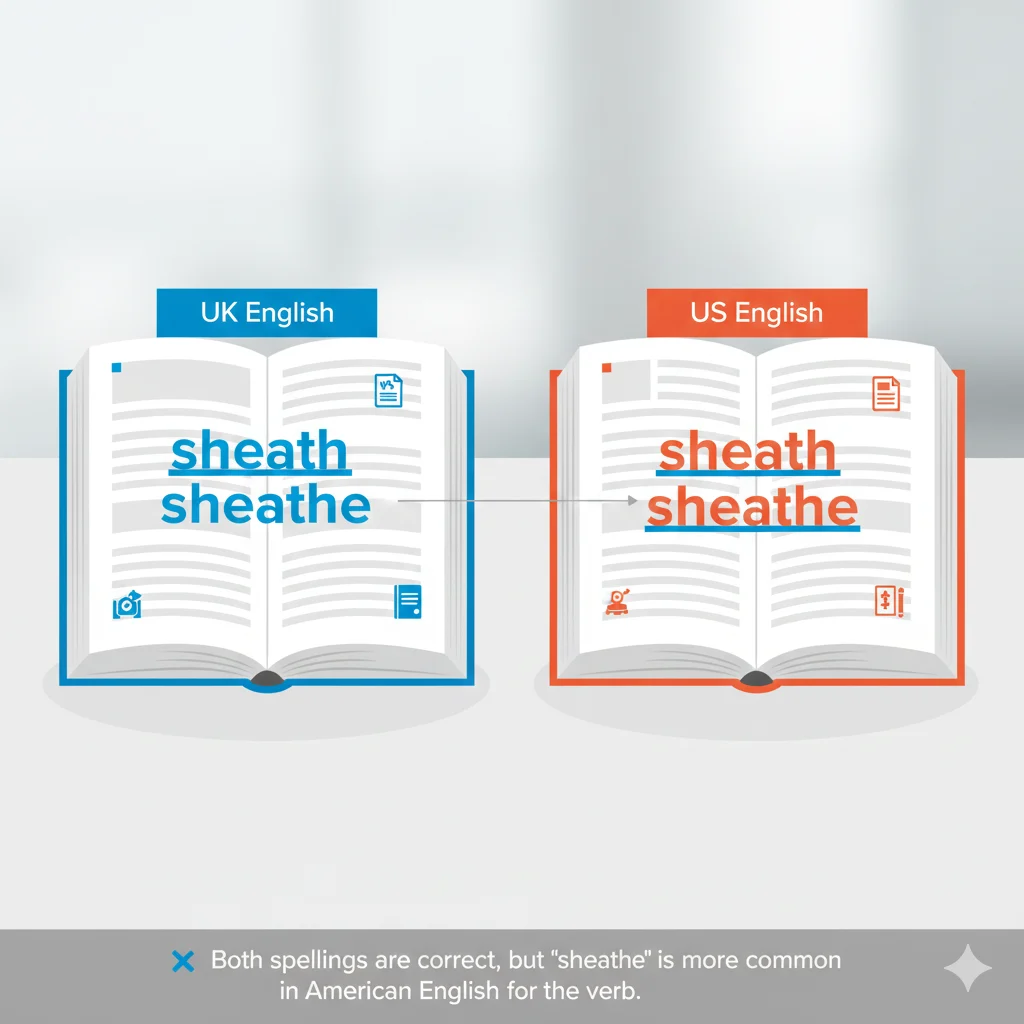
So, while the rules are mostly consistent, Americans may sometimes use “sheath” informally as a verb, but professional writing prefers sheathe.
Which Spelling Should You Use?
Your audience largely determines the correct choice:
- US audience: Use sheath for the noun and sheathe for the verb.
- UK/Commonwealth audience: Stick with sheath (noun) and sheathe (verb).
- Global audience: Following the noun-verb distinction is safest to avoid confusion.
Tips for writers:
- When in doubt, check the context. Are you referring to the object (noun) or the action (verb)?
- In biology and anatomy texts, sheath is usually a noun, as in myelin sheath or muscle sheath.
- For historical or literary writing, follow traditional rules: sheathe your sword.
Common Mistakes with Sheath / Sheathe
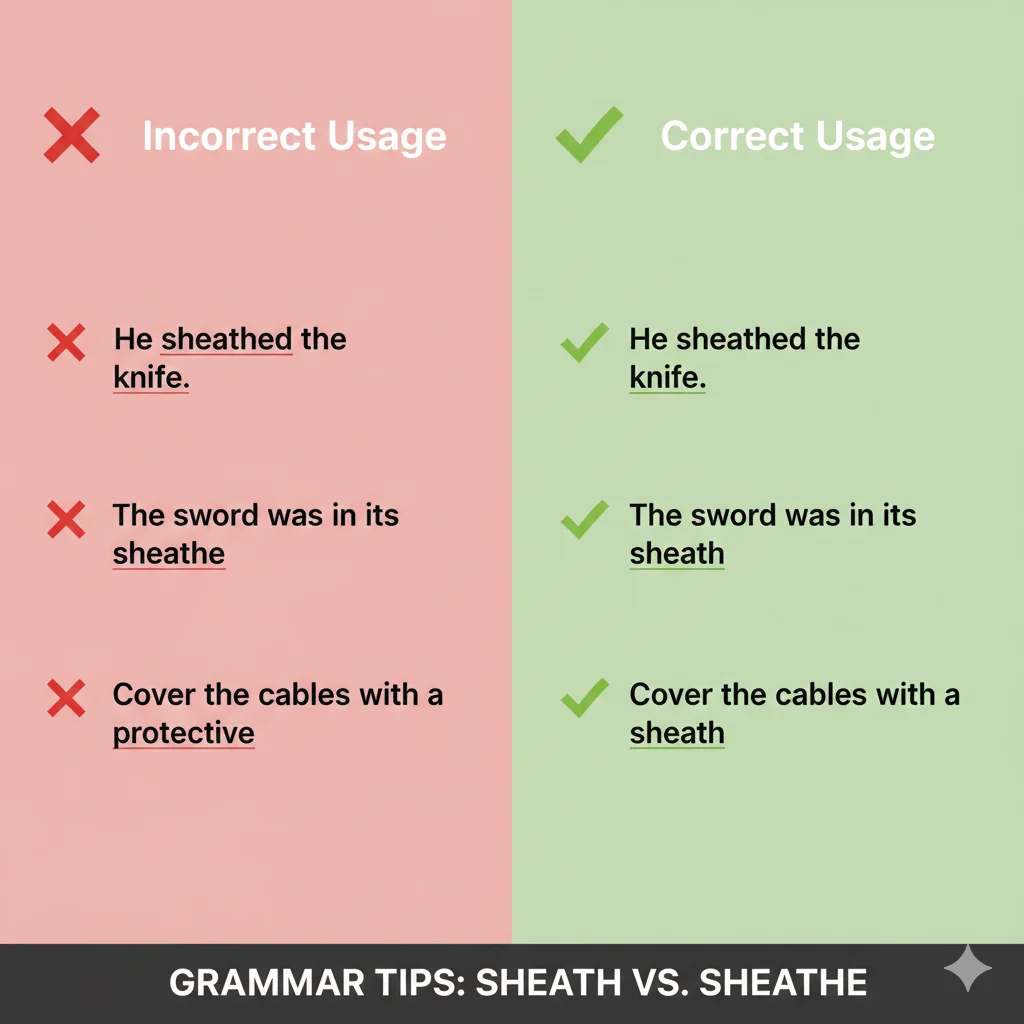
Many people mix up these words. Here are frequent errors and how to fix them:
- Using “sheath” as a verb
- ❌ “He sheath the sword.”
- ✅ “He sheathed the sword.”
- Misspelling “sheathe” as “sheath” in literary contexts
- ❌ “Sheath your sword before entering.”
- ✅ “Sheathe your sword before entering.”
- Confusing plural forms
- ❌ “Three sheathe were on the table.”
- ✅ “Three sheaths were on the table.”
- Using sheath incorrectly in biology or anatomy
- ❌ “The nerve will sheathe.”
- ✅ “The nerve is covered by a sheath.”
- Pronunciation errors
- Correct pronunciation:
- Sheath → /ʃiːθ/
- Sheathe → /ʃiːð/
- Correct pronunciation:
Sheath / Sheathe in Everyday Examples
You can see the words in a variety of real-life situations:
- Emails: “Please sheathe your knives before shipping.”
- News: “The knight sheathed his sword after the ceremony.”
- Social media: “Time to sheathe my worries and focus.”
- Formal writing: “The myelin sheath plays a key role in nerve function.”
- Biology: “The plant’s leaf is protected by a sheath.”
- Anatomy: “The tendon is surrounded by a synovial sheath.”
This variety shows that the word isn’t just literary—it’s practical and scientific.
Sheath / Sheathe – Google Trends & Usage Data
Google searches indicate that most users are looking for clarification:
- Top queries include:
- “Is it sheath or sheathe?”
- “Sheath your sword meaning”
- “Sheath meaning in biology”
- Popular in English-speaking countries: USA, UK, Canada, Australia.
- Usage spikes around historical or fantasy media releases (e.g., medieval films, video games like Skyrim).
Keyword Variations Table:
| Keyword | Search Intent | Example Use |
|---|---|---|
| Sheath | Noun, object | “Insert the knife into its sheath.” |
| Sheathe | Verb, action | “Sheathe your sword before leaving.” |
| Sheath plural | Grammar | “The swords were stored in sheaths.” |
| Sheath meaning in biology | Scientific | “The myelin sheath protects neurons.” |
| Sheath meaning in anatomy | Medical | “The tendon is covered by a synovial sheath.” |
| Sheath your sword meaning | Figurative | “It’s time to sheathe your sword and make peace.” |
| Sheathe pronunciation | Clarification | “Learn to pronounce sheathe correctly.” |
| Is it sheath or sheathe? | Spelling question | “Confused? Here’s the answer.” |
| What does it mean to sheathe your sword? | Idiomatic meaning | “It means to stop fighting or prepare for rest.” |
FAQs
1. Is it sheath or sheathe?
- Use sheath for the noun and sheathe for the verb.
2. What does it mean to sheathe your sword?
- It means to put a sword into its cover or figuratively to stop fighting.
3. What is a sheath sheath?
- This usually refers to a protective layer covering another sheath, often in biology or layered armor.
4. How do you pronounce sheathe?
- Pronounced /ʃiːð/, rhymes with “teethe.”
5. What is meant by sheath in biology?
- A protective covering for cells, nerves, or plant structures.
6. What is meant by sheath in anatomy?
- A layer covering muscles, tendons, or organs.
7. How do you form the plural of sheath?
- The plural is sheaths.
Conclusion
Understanding the difference between sheath and sheathe makes your writing clear and professional. Remember: sheath is the noun, a protective cover; sheathe is the verb, the action of putting something into a sheath. Context determines usage—whether in literature, emails, science, or anatomy.
Check your audience: US, UK, or global readers all expect the noun-verb distinction. Avoid common mistakes like using sheath as a verb or confusing plural forms. When in doubt, refer to this guide or remember the simple rule: object = sheath, action = sheathe.
With this knowledge, you can confidently write about swords, biology, or anatomy and impress your readers with correct usage.

“Rose Tremain is an acclaimed British novelist known for richly imagined historical and contemporary fiction, praised for depth, emotion, and elegant storytelling.”