Many people search for rationale / rational because these two words look similar, sound similar, and are often confused in writing and speech. Students, researchers, professionals, and even native English speakers frequently ask: What is the difference between rational and rationale? or Which word should I use in research or formal writing?
The confusion grows because both words come from the same root and relate to reason or logic. However, their meanings and uses are not the same. Using the wrong one can change the meaning of a sentence or make your writing look unprofessional—especially in academic papers, business emails, or reports.
This article solves that confusion completely. You’ll get a quick answer, clear definitions, pronunciation help, real-life examples, and professional advice on which spelling and word to use. We’ll also cover British vs American usage, Google Trends data, common mistakes, and FAQs people ask online.
By the end, you’ll confidently know what does rationale mean, what does “rational” mean, and how to use both correctly—every time.
Rationale / Rational
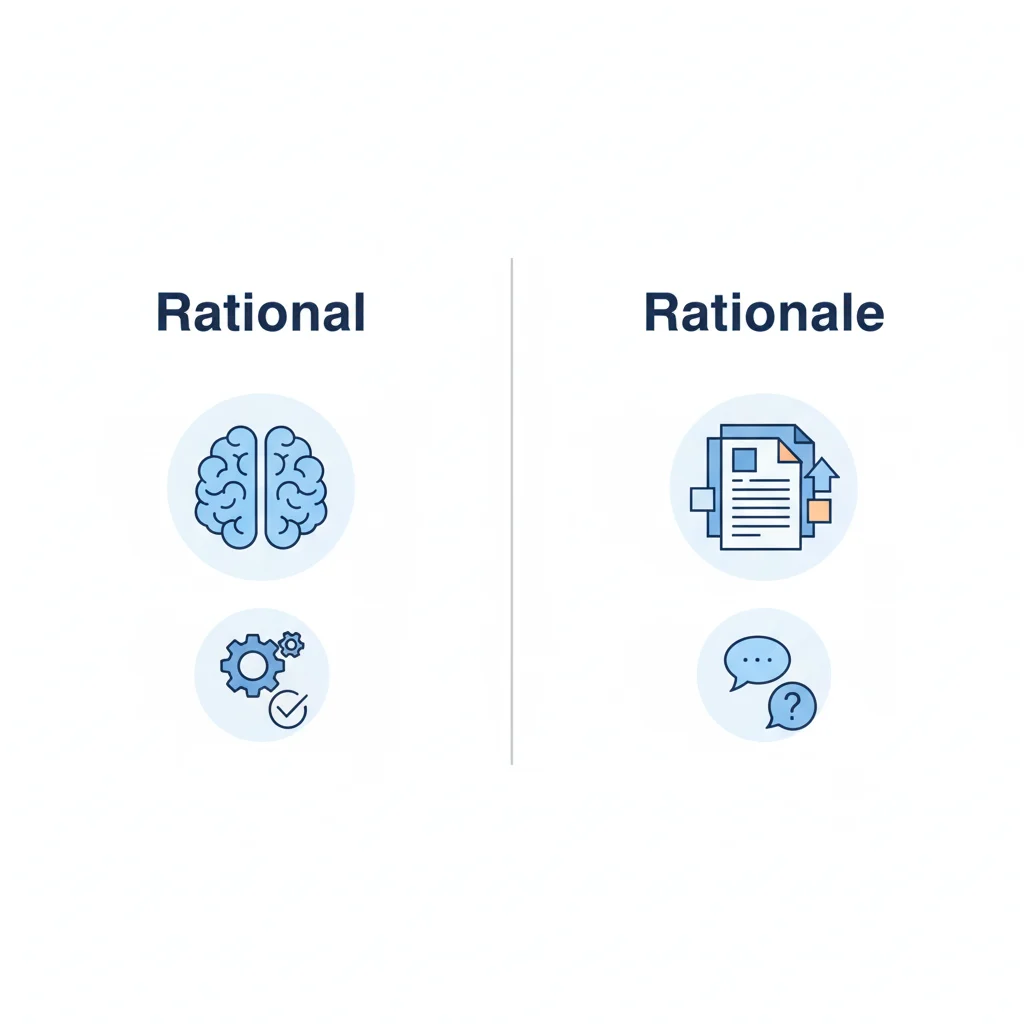
Rational is an adjective.
It describes a person, decision, or action that is logical and reasonable.
Rationale is a noun.
It means the reason or explanation behind a decision or action.
Simple Examples
- She made a rational choice.
- The rationale for the policy was explained clearly.
👉 If you can replace the word with “logical”, use rational.
👉 If you can replace it with “reason”, use rationale.
This quick rule helps avoid mistakes in daily writing, research, and exams.
The Origin of Rationale / Rational
Both rational and rationale come from the Latin word “rationalis”, meaning reasoned or logical.
Word History
- Rational entered English first (14th century).
- Rationale came later (17th century), mainly in academic and formal writing.
Why the Confusion Exists
- Same Latin root
- Similar spelling
- Similar pronunciation
- Related meanings
However, English evolved to give them different grammatical roles:
- Rational → describes behavior or thinking
- Rationale → explains why something was done
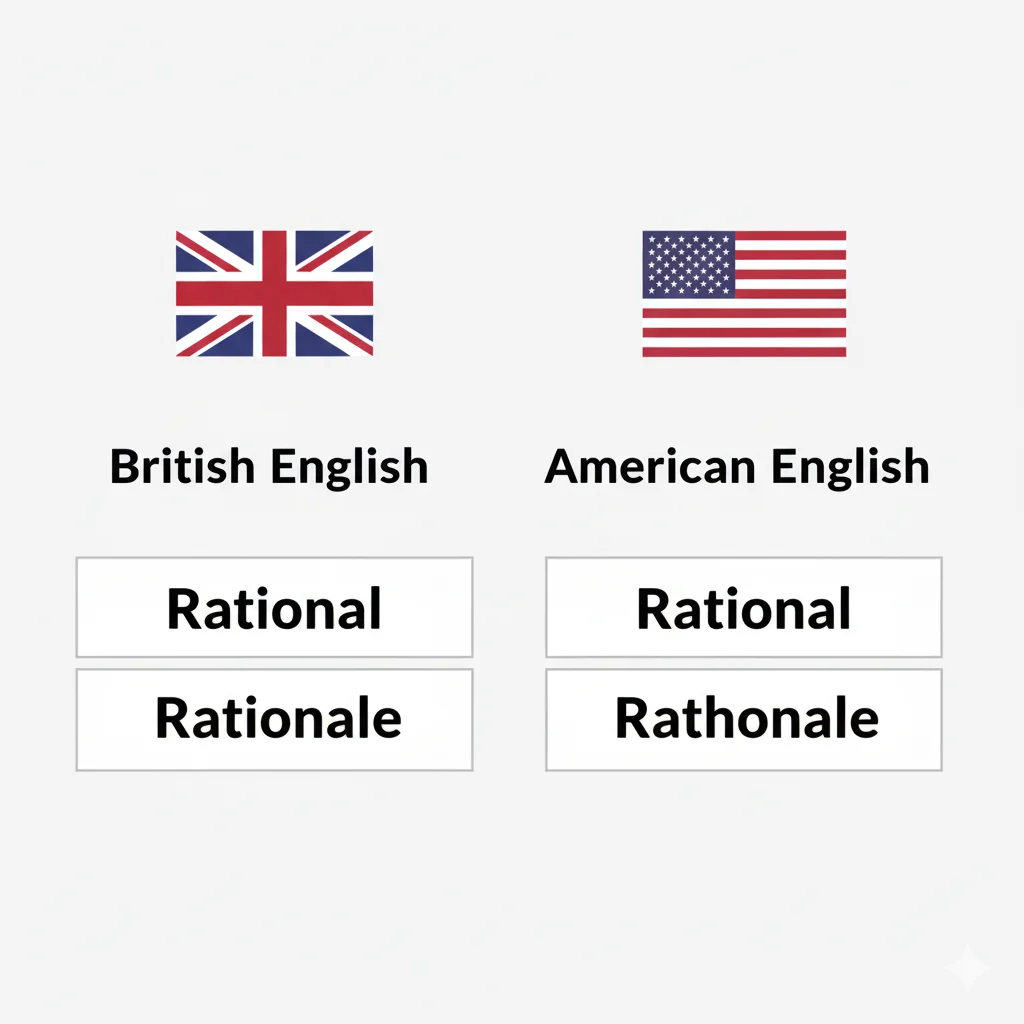
There are no spelling differences caused by British or American English here. The difference is functional, not regional.
British English vs American English Spelling
Unlike words such as colour/color, rationale and rational are spelled the same in both British and American English.
Comparison Table
| Feature | British English | American English |
|---|---|---|
| Rational | Rational | Rational |
| Rationale | Rationale | Rationale |
| Meaning | Same | Same |
| Usage | Same | Same |
✅ No regional spelling change
✅ Only meaning and grammar matter
Which Spelling Should You Use?
The correct choice depends on what you want to say, not where you live.
Use Rational When:
- Describing thinking or decisions
- Talking about logic or reasonableness
Example:
His argument was rational and well structured.
Use Rationale When:
- Explaining reasons
- Writing research papers
- Justifying decisions
Example:
The rationale for the study was explained in the introduction.
Audience-Based Advice
- US audience: Follow grammar rules, not spelling differences
- UK/Commonwealth: Same usage applies
- Global audience: Use rationale in formal writing, rational in descriptive sentences
Common Mistakes with Rationale / Rational
Here are frequent errors and how to fix them:
❌ Incorrect
- The rationale decision was approved.
- He explained his rational clearly.
- This is the rational of the research.
✅ Correct
- The rational decision was approved.
- He explained his rationale clearly.
- This is the rationale of the research.
Easy Fix Rule
- Decision quality → rational
- Decision explanation → rationale
Rationale / Rational in Everyday Examples

1. Emails
- Rational: This is a rational approach to the problem.
- Rationale: Please explain the rationale for this change.
2. News Writing
- The minister gave a rational response.
- The rationale behind the law was debated.
3. Social Media
- Try to stay rational during arguments.
- What’s the rationale for this update?
4. Formal & Academic Writing
- Rational or rationale in research is a common question.
- In research papers, rationale explains why the study exists.
Example:
The rationale of this research is to analyze climate trends.
Rationale / Rational – Google Trends & Usage Data
Google search data shows:
- “What is the difference between rational and rationale?” is searched globally.
- Students and researchers drive most searches.
- Highest usage:
- United States
- India
- United Kingdom
- Australia
Usage by Context
| Context | Common Term |
|---|---|
| Academic | Rationale |
| Psychology | Rational |
| Business | Both |
| Research Papers | Rationale |
| Daily Speech | Rational |
Keyword Variation Table
| Keyword Variation | Usage |
|---|---|
| Rationale meaning | High |
| Rational meaning | High |
| Rationale synonyms | Medium |
| Rationale rational examples | Medium |
| Rational vs rationale pronunciation | Rising |
| Rationale rational in a sentence | High |
Rational vs Rationale Pronunciation
Many users ask: How do you pronounce rationale vs rational?
- Rational: rash-uh-nuhl
- Rationale: rash-uh-nal
The difference is subtle.
Rationale ends with a softer “al” sound.
Tip
If pronunciation feels tricky, focus on grammar, not sound.
Rationale and Rational Meaning (With Synonyms)
What Does “Rational” Mean?
Logical, sensible, based on reason.
Rationale rational synonym (for rational):
- Logical
- Reasonable
- Sensible
- Sound
What Does Rationale Mean?
The reason or justification for something.
Rationale synonyms:
- Reason
- Explanation
- Justification
- Basis
- Purpose
Rationale / Rational – FAQs
1. What is the difference between rational and rationale?
Rational describes logic. Rationale explains reasons.
2. What does rationale mean?
It means the reason behind a decision or action.
3. What does “rational” mean?
It means logical and reasonable thinking or behavior.
4. Can rationale be used as an adjective?
No. Rationale is always a noun.
5. Rational or rationale in research?
Use rationale to explain why the research exists.
6. How do you pronounce rationale vs rational?
They sound similar, but rationale ends softer.
7. Are rationale and rational interchangeable?
No. They serve different grammatical purposes.
Conclusion
The confusion between rationale / rational is common—but easy to fix once you understand the difference. While both words relate to logic and reason, they serve very different roles in English.
Use rational when describing a person, thought, or decision that is logical and sensible. Use rationale when explaining why something was done, especially in formal, academic, or professional contexts. This distinction is crucial in research writing, business communication, and exams.
There is no British or American spelling difference, so your focus should always be on meaning and grammar. Remember the simple rule: logical = rational, reason = rationale.
By applying the examples, tables, and usage tips in this guide, you can write with clarity and confidence. Whether you’re drafting an email, publishing research, or preparing content for a global audience, you now know exactly which word to choose—and why.

“Elizabeth Gaskell was a Victorian novelist known for compassionate social realism, memorable characters, and classics like North and South and Cranford.”